In this lecture (15 January)
- End of the pyramid example
- 0-dimensional holes and reduced vs classical homology
- Example: the hollow tetrahedron (a 2-dimensional hole)
- Collapses do not change homology
- Euler–Poincaré theorem
- Groups, pseudo-metrics, group actions
- Data as functions and functions on a simplicial complex, isomorphisms,
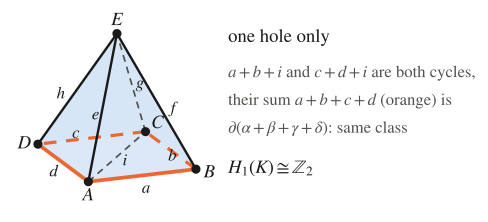
The pyramid: one hole
We finished the example of Lecture 3 (pyramid with open base plus the diagonal of the base): with , , , and , , , ,
: is the trivial space, no cavity. : , exactly one hole. The loops around the two halves of the open base are in the same equivalence class.
0-dimensional holes are disconnections
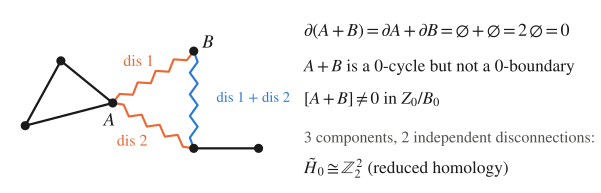
In reduced homology every vertex has boundary , so for any two vertices
is a 0-cycle. It is a 0-boundary iff and are joined by a path of edges, since the boundary of a path is the sum of its endpoints. In the picture and lie in different components, so is a 0-cycle but not a 0-boundary, and in . A 0-dimensional hole is just a disconnection.
The picture has 3 connected components, hence 2 independent disconnections (dis 1 and dis 2; their sum is again a disconnection), so in reduced homology .
Reduced vs classical simplicial homology
The only difference is in degree , i.e. in what we do with the empty simplex.
| Reduced (RSH), written with a tilde | Classical (CSH) | |
|---|---|---|
| (generated by the empty set) | ||
| boundary of a vertex | (the empty simplex) | (the null chain) |
| (if has a vertex) | ||
| counts | the disconnections (components ) | the connected components |
Since and only changes,
while for . With 3 components: and . Reduced homology is convenient because a point (or any collapsible complex) has all reduced Betti numbers equal to .
Example: the hollow tetrahedron
Let be the boundary of a tetrahedron: 4 triangles, no 3-simplex.
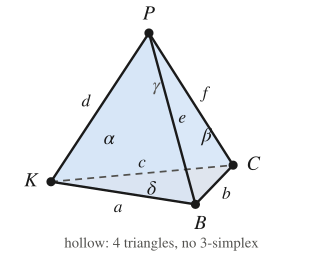
Labels (from the drawing): vertices , where is a vertex name and not the complex, and the right vertex is . Edges: , , (the hidden back edge), , , . Triangles: , , (back face), (the bottom, shaded orange).
, , (and in reduced homology).
- : is empty, because (no 3-simplex), hence .
- , with
Every edge belongs to exactly two triangles, so : the four columns sum to . Any three columns are independent (rows show it for ), so . The 2-chain is a 2-cycle (a closed surface) that is not a boundary.
- , with
The graph is connected with 4 vertices, so .
- .
Typos in the handwritten matrices
The handwritten and contain a few typos (e.g. an edge listed in three triangles, which is impossible on a closed surface where each edge is shared by exactly two triangles). The matrices above are the correct ones for the labels of the drawing; the ranks are the same as in the notes.
: one 2-dimensional hole, the cavity inside the tetrahedron. There are no 1-dimensional holes (every loop on the surface bounds a piece of surface) and is connected. If we fill the tetrahedron by adding the 3-simplex, then and : the cavity disappears.
Collapses do not change homology
Recall the elementary collapse: if has a unique proper coface , remove both.
Theorem – Collapses preserve homology
If the simplicial complex is obtained from by an elementary collapse, then
Proof with the tools of the course
Let , so . Passing from to : and decrease by 1, all other are unchanged. Let us look at the ranks.
- loses the row and the column . Row contains a single 1, in column , because is the only coface of . Removing a row and a column that share such an isolated pivot lowers the rank by exactly 1: decreases by 1.
- loses the column , i.e. the vector . Since and , we get , which already lies in the span of the remaining columns. So does not change.
- loses the row , which is zero since has no cofaces. So does not change.
Hence, with : is unchanged, is unchanged, and all the others are obviously unchanged. Geometrically: is a deformation retract of .
Example. The pyramid of Lecture 3 collapses to a hollow triangle.
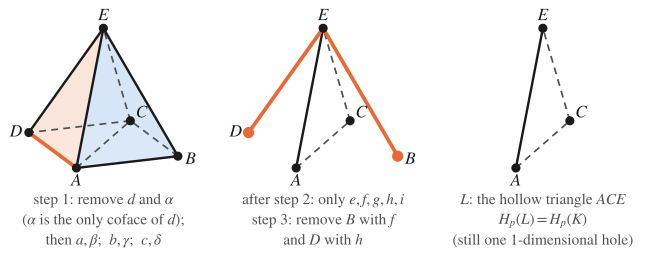
With the labels of Lecture 3:
- the base edge has a single coface, the triangle : remove and ;
- repeat for every base edge: remove with , with , with . All the triangles are gone; what is left are the edges from the apex and the diagonal ;
- now and have a single coface each ( and ): remove with and with .
What is left is the hollow triangle with vertices and edges . Its homology is that of the pyramid: one 1-dimensional hole, . Collapsing is a cheap way to simplify a complex before computing its homology.
Euler characteristic and the Euler–Poincaré theorem
Definition – Euler characteristic
Example: the hollow tetrahedron has (4 vertices, 6 edges, 4 triangles).
Theorem – Euler–Poincaré
where the are computed in classical simplicial homology.
Hollow tetrahedron, in classical homology ( = number of components ): . ✓
Proof
Write and use :
In (2) set :
So . All the terms with indices cancel, leaving
because (there are no -simplices) and in classical homology. Hence .
In reduced homology , and the same computation gives , consistent with .
What is it good for?
- is computed by just counting simplices, with no matrices, yet it equals an alternating sum of Betti numbers, which are topological invariants. So any triangulation of the same space has the same , even with a completely different number of simplices. For example for every triangulated sphere (Euler’s formula for convex polyhedra).
- It is a sanity check: after computing the Betti numbers, their alternating sum must equal . For the pyramid of Lecture 3: and . ✓
- If all Betti numbers but one are known, gives the missing one for free.
Groups, pseudo-metrics, group actions
From here on the course moves to the second theme: comparing data up to transformations. We need some vocabulary.
Definition – Group
A group is a set with a binary operation () such that:
- associativity: ;
- identity: there is with for all ;
- inverses: for every there is with .
The group is abelian (commutative) if for all .
Example: the set of all isometries of the real plane, with composition, is a group. It is not abelian: rotating and then translating is in general different from translating and then rotating.
Definition – Pseudo-metric
A pseudo-metric on is a function with , and . It is a metric without the property
Distinct points may be at distance . For instance on functions only looks at the value at . The natural pseudo-distance of Lecture 5 is of this kind.
Definition – Group action
A (left) action of a group on a set is a map , , such that
- for all ;
- for all , .
The orbit of is .
- If is a group of transformations (bijections) of , the action is just evaluation: .
- Right actions satisfy instead . This is our case: a group of transformations of the domain acts on functions by right composition, , and indeed . (Equivalently, is a left action.)
Order of the product
The handwritten notes write the second axiom as (and the first one as ""). For a left action the correct order is ; the order is the one of a right action, like .
Data as functions
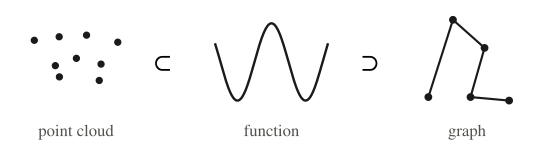
Data come in many forms: point clouds, functions, graphs… The viewpoint of the course is to represent data as functions: a datum is a measurement . A grayscale image is a function from the pixels to , a time series is a function of time, a graph can carry values on its vertices.
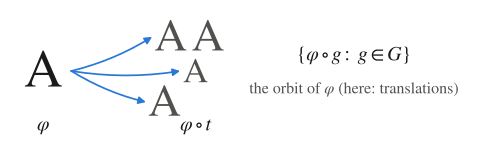
Different functions can represent “the same” datum for a given observer. A letter A and its translated copies are different functions, but for an observer who does not care about the position they are the same datum. If is a translation, and are equivalent, and the set is the orbit of under the group of translations.
The framework:
- Function space: a set of functions (or ) defined on a fixed domain ; a metric space is enough as domain. They are the admissible functions, the data that our instruments can produce. Not every function is admissible data.
- Group: a group acting on by right composition, (we need ).
Functions on a simplicial complex
We now formalise this for simplicial complexes. Let be a geometric simplicial complex with vertex set , and a set of functions (values on the vertices).
Definition – Extension by max
Every is extended to all simplices of by taking the maximum over the vertices:
The set of extended functions is : the “legitimate” functions (measurements) in the simplicial framework.
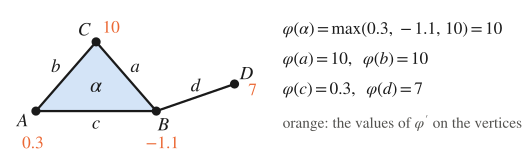
With , , , : , , , .
Why the maximum?
With the max, a face never has a larger value than the simplex containing it: . Hence every sublevel set is closed under faces, i.e. it is a subcomplex. This is exactly what persistent homology needs (Lecture 5). (This construction is known as the lower-star filtration.)
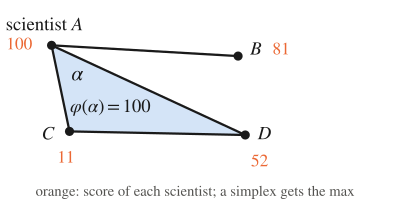
Example: a complex whose vertices are scientists, with a score on each vertex (e.g. a number of publications: A 100, B 81, C 11, D 52). A simplex, e.g. a group of co-authors, gets the maximum score of its members: .
Which transformations? To compare such functions we need a group acting on them. The natural transformations of a simplicial complex are its isomorphisms.
Definition – Simplicial isomorphism
Let be simplicial complexes. A bijection is a simplicial isomorphism if
It extends to a bijection between simplices, for . Since is a bijection, simplices go to simplices of the same dimension.
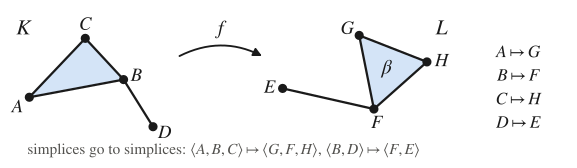
Here sends the triangle to the triangle and the edge to the edge .
Definition – and
- is the set of all isomorphisms .
- is the set of isomorphisms that preserve :
is a group under composition: if preserve , then so do (since ) and (the definition is symmetric in and ). It contains the transformations that our measurements cannot “break”. It is the starting point of Lecture 5.
Recap
- 0-dimensional holes = disconnections. Reduced: and . Classical: and .
- Hollow tetrahedron: in reduced homology: one cavity.
- Elementary collapses do not change homology.
- (classical homology).
- Group, pseudo-metric ( does not imply equality), group action; acts on functions by .
- Functions on : values on the vertices extended by max, so sublevel sets are subcomplexes. = isomorphisms of preserving .
Handwritten source: tdafull.pdf, page 4