In this lecture (13 January)
- What homology is for
- Chain groups
- The boundary operator and the boundary of a boundary is zero (Proposition 13)
- Cycles, boundaries and holes: why counts holes
- Betti numbers via matrix ranks (Proposition 14)
- Worked example: the pyramid with open base
Recall from Lecture 2: a chain complex is a sequence of vector spaces with linear maps such that . Its -th homology group is
Today we build a chain complex out of a simplicial complex ; its homology is the simplicial homology . We always work with coefficients in .
What homology is for: counting holes
The purpose of is to count the -dimensional holes of .
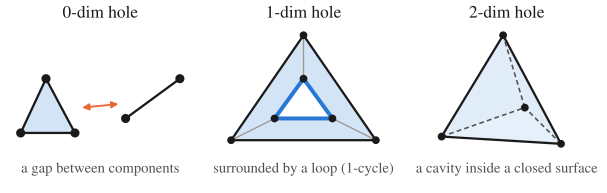
A hole is a cavity that is “surrounded” by something, and its dimension is the dimension of what surrounds it:
- 0-dimensional holes: gaps between connected components (a component is “surrounded” by points);
- 1-dimensional holes: tunnels/loops, i.e. a closed curve that does not bound a filled region (e.g. a hollow triangle);
- 2-dimensional holes: cavities enclosed by a closed surface (e.g. the inside of a hollow tetrahedron or of a sphere).
So “dim(hole) = dim(the cycle that surrounds it)“.
Chain groups of a simplicial complex
Definition – Chain group
is the set of formal linear combinations with coefficients in of the -simplices of :
Its elements are the -chains. It is a vector space over whose natural basis is the set of -simplices, so
Over a -chain simply selects a set of -simplices, and the sum of two chains is the symmetric difference of the two sets.
Running example ( = triangle with edges , , , plus the edge ):
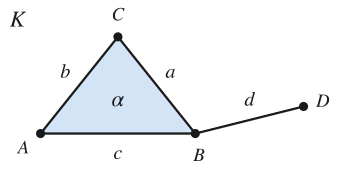
- : all combinations of , e.g. . These are 16 elements:
with and .
-
: elements, .
-
: only one triangle, .
-
, the null space, for : there are no simplices of those dimensions.
-
: the only -simplex is the empty set. It depends on the convention:
- reduced homology (the one we use for now): , generated by the empty simplex, so (two elements);
- classical homology: .
The two conventions are compared in Lecture 4.
Notation: vs
The handwritten notes often write for the zero chain (e.g. "", ""). Here we keep them distinct:
- is the null vector of (the empty selection of simplices);
- is the empty simplex, a basis vector of in reduced homology.
They are different objects: in , but .
The boundary operator
The boundary of a triangle should be the sum of its three edges:
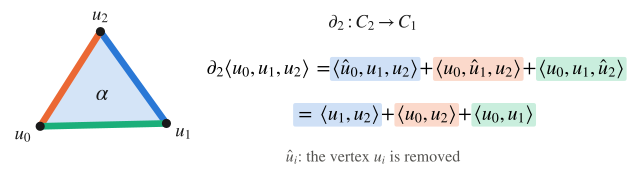
where the hat means “remove ”.
Definition – Boundary operator
is the linear map defined on the natural basis of by
(the sum of the -faces of the simplex), and extended by linearity: .
In low dimensions:
- : the boundary of an edge is the pair of its endpoints;
- in reduced homology ( in classical homology);
- when .
In the running example , , and : cancels because .
The boundary of a boundary is zero
Example on a triangle:
because in we have (2 mod 2 = 0). Each vertex appears twice, once for each edge that contains it.
Proposition 13 –
For every , . Hence is a chain complex.
Proof
By linearity it suffices to check a simplex . For let
(remove both and ), and set if . Then
In the fourth equality we extended the sums to all , which adds only null terms since for and for . In the fifth we renamed the indices of the first double sum. In words: each -face (remove and ) is obtained exactly twice, removing first and then or the other way round, and in .
Intuition: “the boundary of a boundary is empty”. The boundary of a triangle is a closed loop, and a closed loop has no endpoints.
So for a simplicial complex we can define its homology
Cycles, boundaries and holes
Definition – Cycles and boundaries
- : the -cycles, chains with zero boundary (closed chains, e.g. closed loops of edges);
- : the -boundaries, chains that bound a -chain;
- by : every boundary is a cycle.
Why do homology groups count -holes? Imagine a point cloud turned into a complex : the holes of are what we want to detect.
A cycle that is also a boundary. , so is a cycle; it is the boundary of the filled triangle , so it surrounds nothing empty.
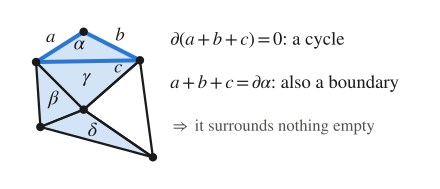
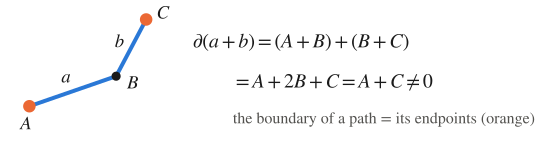
A chain that is not a cycle. A path is not closed: its boundary is the pair of its endpoints, .
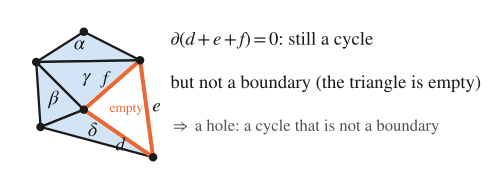
A cycle that is not a boundary. , so is still a cycle. The three edges bound the right triangle, which is not filled (not shaded: it is not a 2-simplex of the complex), so is not the boundary of any 2-chain. It detects a hole.
Key idea
A hole is a cycle that is not a boundary.
Different cycles, same hole. Two loops going around the same hole should count as one hole, not two:
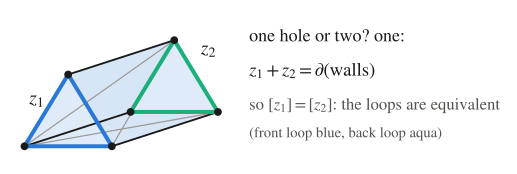
Think of the tent as a triangular tube with filled walls. The loop around the front opening and the loop around the back opening are two different cycles, but they surround the same tunnel: their sum is the boundary of the walls between them (the cycles “have a common boundary”), so they are equivalent. This is what the quotient does:
(over , ). Such cycles are called homologous. In :
- cycles that are boundaries become (no hole);
- homologous cycles become the same element (same hole).
So is the number of independent -holes.
Computing homology with linear algebra
We will use linear algebra to compute homology groups. Define
| symbol | meaning | name |
|---|---|---|
| number of -simplices | -chains | |
| -cycles | ||
| -boundaries | ||
| -th Betti number (-holes) |
Since is a vector space over , it is determined up to isomorphism by its dimension: . Computing is equivalent to computing the homology group.
Proposition 14
Proof
We use the rank–nullity theorem twice ().
- (A) The projection , , is surjective with :
- (B) For :
(because ).
Substituting (A) in (B): , i.e. .
is obtained by counting simplices. For : let be the matrix of with respect to the natural bases of and . It has one row per -simplex and one column per -simplex, and the entry is iff the row simplex is a face of the column simplex. Then
computed with Gaussian elimination mod 2.
Compute ranks over , not over
Example: the hollow triangle (vertices , edges , , ) has
Over its determinant is , so the rank is 3. Over the three rows sum to and the rank is 2. The correct value is , which gives : one hole. With the real rank we would wrongly find no hole. Working mod 2 is what allows us to forget orientations.
First example (the running ). , , , (reduced).
- : is the single non-zero column ;
- : every column has two 1s, so the 4 rows sum to and the rank is ; the edges form a spanning tree, so they are independent;
- (every vertex has boundary ) and (no 3-simplices).
Then , , : no holes of any dimension. Indeed is a filled triangle with a tail, which can be shrunk to a point.
Worked example: pyramid with open base
is the surface of a square-based pyramid without the base, plus the diagonal of the base: 4 triangles + 1 extra segment. What is ?
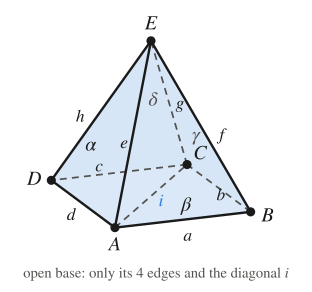
Labels (deduced from the boundary matrices of the handwritten notes; dashed edges are hidden behind the surface):
- vertices: (the base square) and the apex ;
- edges: , , , (base square), , , , (lateral edges), (diagonal of the open base);
- triangles: , , , .
Counting: , , , , for (19 simplices in total).
, where is the matrix of (rows: edges, columns: triangles):
Each column has a “private” row: only in , only in , only in , only in . So the columns are independent and : . In the notes the same result is obtained by moving one column and reading off 4 pivots.
, the matrix of (rows: vertices, columns: edges):
Every column contains exactly two 1s (the endpoints), so the five rows sum to and the rank is . The columns are independent (each one has a private row among ). So . In general, for a graph, .
The other ranks. : in reduced homology , since for every vertex. : there are no 3-simplices, so . Also .
Betti numbers with :
Interpretation. The hole is the open base. The base contains two triangular loops, (around ) and (around ). Both are cycles and neither is a boundary, but
since . The two loops are homologous (they differ by the boundary of the lateral surface), so they represent the same hole: one hole, not two. The result is drawn in Lecture 4.
Recap
- : -combinations of -simplices, .
- and (Prop. 13).
- (cycles), (boundaries), . A hole is a cycle that is not a boundary, and homologous cycles are the same hole.
- (Prop. 14), with .
Handwritten source: tdafull.pdf, page 3